There is a lot of conflicting advice around heat pumps, underfloor heating and zoning. Some of it comes from real-world experience and learnt lessons, but much of the advice is based on older systems, trying to solve poor installations, or partial truths.
In reality, good heating design can deliver both high efficiency and excellent zoned or room-by-room comfort as long as the system is designed properly.
This guide separates some of the most common myths from what actually happens in real homes.
Modern heating standards are actually built around comfort in each occupied space, not just one average temperature for the whole home. Standards such as ISO 7730 and ISO 11855 consider factors like room temperature, floor surface temperature, draughts and radiant comfort. Because bedrooms, bathrooms and living areas all have different comfort needs, a single thermostat cannot properly satisfy every space at once. This is why room-by-room or zone-by-zone control is such an important part of good heating design and should be an important consideration for your home.
Does zoning reduce heat pump efficiency?
The myth:
Running multiple heating zones, such as individual room thermostats, makes heat pumps less efficient especially when only one or two rooms are calling for heat.
The reality:
Zoning only causes problems when systems are poorly designed or through a misinterpreted understanding of thermostatic controls.
Real issues such as short-cycling, high flow temperature operation or inefficient operation usually have come from:
- fixed-speed heat pumps that cannot modulate their output;
- heat pumps that are oversized for their systems;
- poor control strategies;
- insufficient system volume or buffering;
- very small zones calling for heat on their own.
In these situations, the heat pump may produce more heat than the active zone can absorb. This can cause the system to switch on and off repeatedly, which reduces efficiency and can place extra strain on the heat pump.
However, modern inverter-driven heat pumps work differently. They can reduce their output to match the heating demand. Instead of running at full power in one small area and switching off, they can run steadily at a lower power level.
This is where heat pumps perform best: steady operation, low flow temperatures and gradual heat delivery.
Bottom line:
Zoning does not inherently reduce heat pump efficiency. With the right heat pump, controls and system layout, zoning can work with the heat pump not against it.
Does heat “leak” between rooms and cancel out zoning savings?
The myth:
If you turn the heating down in unused rooms, heat from warmer rooms will simply drift into those cooler areas, so you do not actually save energy.
The reality:
Heat transfer between rooms does happen, but in most homes it is small and manageable.
Heat can move between rooms through:
- internal walls, floors and ceilings;
- gaps around doors;
- open doorways;
- air movement between spaces.
However, normal homes already limit much of this transfer. Closed doors significantly reduce air movement, and sensible zoning layouts help keep warm and cooler areas separated.
The worst results tend to happen in extreme or poorly managed situations for example, when warm and cool rooms are scattered throughout the house, internal doors are left open, or the system is forced to compensate with higher flow temperatures.
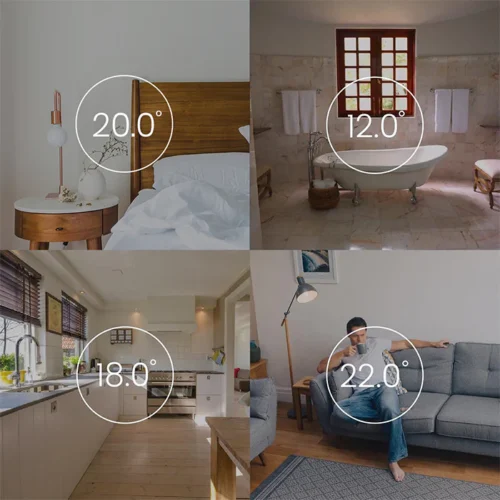
In typical use, turning down (rather than off) unused rooms can still reduce overall heat demand and increase energy efficiency. The key is not to create freezing cold rooms next to overheated rooms, but to use sensible temperature setbacks (lower temperatures).
It is worth keeping in mind that different rooms have different functions and different temperatures are required for them.
For example, it may make sense to:
- keep bedrooms slightly cooler (16-19°C )than living areas (20–22°C);
- reduce heat in guest rooms when not in use;
- set back a home office outside working hours;
- keep doors closed between warmer and cooler zones.
Bottom line:
Heat leakage is real, but it usually does not cancel out the benefits of zoning. Used sensibly, zoning can still reduce energy use while improving comfort.
Is one temperature throughout the home better for comfort?
The myth:
A single thermostat controlling the whole house gives consistent comfort.
The reality:
Comfort is not the same in every room.
Different spaces are used in different ways, at different times of day. A living room may feel best at around 20–21°C. Bedrooms are often more comfortable slightly cooler, especially at night. Bathrooms may need to feel warmer for short periods, while a home office may only need heating during working hours.
A single thermostat cannot respond properly to all of these needs. A single central thermostat also leads to less accurate management and underheating and overheating issues and wasted energy.
If the thermostat is in a warm hallway, it may switch the heating off before colder rooms have reached temperature. If it is in a cold area, it may keep the system running until other rooms become too warm.
This often leads to:
- overheated rooms;
- underheated rooms;
- wasted energy;
- poor comfort balance.
Zoning solves this by allowing each room or area to be heated according to how it is actually used. Rather than forcing the whole house to follow one temperature, zoning gives each space its own comfort setting and schedule.
Bottom line:
One temperature rarely suits the whole home. Zoning creates a more comfortable, flexible and practical heating system.
How to make zoning efficient with a heat pump
A well-designed zoned heating system avoids the common problems that give zoning a bad reputation.
The key principles are:
Use a modulating heat pump
An inverter-driven heat pump can adjust its output to match demand. This helps avoid inefficient stop-start cycling when only part of the home needs heat.
Maintain enough system volume
Buffer tanks, low-loss headers, open circuits or correctly designed manifolds can help ensure the heat pump always has enough water volume and flow to operate safely and efficiently.
Use smart controls
Weather compensation, smart controls and gradual control strategies help keep flow temperatures low and stable. The system should not respond to a small zone calling for heat by immediately driving up the flow temperature.
Group zones logically
Bedrooms, living areas, bathrooms and workspaces often have different heating needs. Grouping rooms logically helps reduce unwanted heat transfer and makes the system easier to control.
Size the system correctly
Oversizing is one of the main causes of heat pump inefficiency. A well-sized system, designed around the heat loss of the property, will usually perform better than one that is simply made larger “just in case”.
Bottom line:
Zoning works best when the whole system is designed around how heat pumps actually operate: low temperature, steady output and controlled heat delivery.
Do heat pumps need to run constantly?
The myth:
You should never turn a heat pump off. It must run 24/7 to stay efficient.
The reality:
This advice came from real limitations, but it is often applied too broadly.
Historically, many systems worked better when left running continuously because:
- traditional screed underfloor heating was slow to respond;
- older heat pumps struggled with stop-start operation;
- air source heat pumps can be less efficient in very cold outdoor temperatures;
- reheating a cold home could require higher flow temperatures.
So the advice to “leave it on” was not wrong. It was a practical response to slower, older or less flexible systems.
But modern heating systems can be much more responsive.
A Wundafloor, using Wunda Rapid Response® underfloor heating, for example, is designed to warm up far more quickly than traditional screed systems. Because it uses low thermal mass boards rather than a thick screed slab, heat is transferred into the room faster. This means homeowners do not need to keep the whole system trickling heat all day just to avoid long warm-up times.
This changes how the system can be used.
Rather than heating every room continuously, homeowners can use smart schedules and gentle setbacks to match heating to their routine. Rooms can be warmed when needed and turned down when they are not in use.
Ground source and water source heat pumps also change the equation. Unlike air source heat pumps, which are affected by outdoor air temperature, ground and water source systems draw heat from a more stable source. This means they are less exposed to the night-time efficiency drop that air source systems can experience in cold weather.
That does not mean every heat pump should be switched fully off for long periods. Deep setbacks in poorly insulated homes, or with slower heating systems, can still cause comfort issues or inefficient recovery.
A better rule is to avoid large temperature swings, but use smart scheduling where the system can recover efficiently.
Bottom line:
The blanket advice to “never turn it off” is mostly misunderstood today. With the right system design, smart scheduling and gentle setbacks can save energy without sacrificing comfort.
Final takeaways
Zoned heating and heat pumps are not in conflict. Poorly designed systems with the wrong heating emitter, or a misunderstanding of the past can create problems, but well-designed systems using the correct heat emitters can deliver excellent efficiency and better comfort.
The reality is:
- zoning does not reduce efficiency, poor design does
- heat leakage between rooms is usually manageable
- room-by-room control improves comfort
- modern heat pumps can operate flexibly
- rapid-response underfloor heating reduces the need for constant background heat
- smart controls help keep flow temperatures low and stable
The goal is not to heat every room the same way all day. The goal is to deliver the right amount of heat, to the right rooms, at the right time, using the lowest practical flow temperature.
With the right combination of heat pump, controls and modern underfloor heating (such as our Rapid Response® Wundafloor), homeowners do not have to choose between comfort, control and efficiency. They can have all three!