Laminate floor coverings and underfloor heating
Laminate is now a popular choice as a floor covering due to its affordability and the vast range of styles available today. Whether you want to replicate wood, tile or stone there are endless choices, with the added bonus of it being easy to clean, usually scratch and spill resistant and pretty durable.
Most laminate floors work very well with underfloor heating. Please remember it is important to check with your flooring supplier that your choice will work with underfloor heating and if there are any floor surface temperature limitations that would require the use of a floor probe.
These guidelines have been created to help you confidently install laminate floor coverings over your Wunda Rapid Response® boards as part of a complete Wundafloor® system.
When installed correctly, your Wundafloor provides a stable, efficient, and highly responsive heated floor designed to work seamlessly with laminate floor finishes.
Your Laminate floor finish can be installed on the Rapid Response panels in a number of ways. In order for a smooth process, please take into account the following guidance:
Preparation:
Please ensure the laminate is allowed to acclimatise before installing, check your suppliers’ instructions for more details.
In order to protect your floor, it is necessary to use a room sensor or thermostat that has a facility to accommodate a floor probe, which is located directly under the floor finish. This will be set to cut out the heating at a floor surface temperature of 27°.
Installation Method 1 – Free Floating
The first and most popular is for it to be free floated using a suitable underlay. We can provide an optional 2mm breathable XPS underlay with an R value of approx. 0.056m²K/W.
Installation Method 2 – Self Levelling Compound
When doing small form factor laminate including herringbone and chevron patterns it is recommended to use one of the approved levelling compounds as an intermediate layer. An approved self levelling compound could be used on top of the Rapid Response® panels. Then, the laminate floor finish can be laid on top.
It is important to carry out a pressure test of the floor heating system and pipes prior to applying any primers and levelling compounds.
Before pouring any levelling compounds, ensure that all Rapid Response® boards are securely bonded to the subfloor and that there is no movement in the boards. It is important that any movement in the boards or joints between boards is addressed and remedied before levelling compounds are poured. Additional Secure fixing of the boards may be required using large washers and screws, if movement is detected.
It is crucial to always prime the boards first with the approved and relevant primer, before laying the approved self levelling compound.
The Wunda approved levelling compounds and primers are:
‘10mm ProLevel Ultimate’, when primed using ‘Ultra Prime it multi surface primer’. ‘10mm Mapei Ultraplan Renovation Screed’ when primed with ‘Mapei Eco Prim Grip’
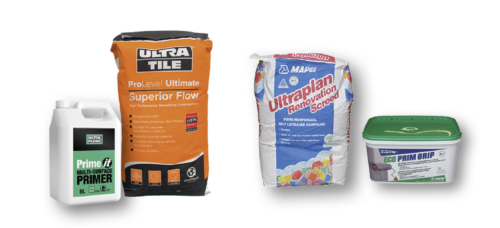
The levelling compounds and primers are not provided by Wunda. They can be sourced from local merchants or online and the relevant ratios will be included on their instructions.
Self Levelling Compound Curing time
Tile adhesives and levelling compounds/screeds must be allowed to cure naturally. Be sure to check the manufacturer’s specific requirements. Do not use the underfloor heating system to accelerate the curing process.
When activating the heating, increase the temperature gradually. If you have a mixing valve begin with the it set to the minimum position and increase slowly by up to 5°C each day until the desired operating temperature is reached. If you are coming from a low temperature heat source, ensure the flow temperature supplied is low to start and slowly increased by up to 5°C each day until the desired operating temperature is reached.
Installing the laminate floor finish
When laying the floor finish, an expansion gap needs to be incorporated around the perimeter, please be sure to check your supplier’s instructions.
If possible, try to ensure the laminate runs at 90° perpendicular to the pipe runs to avoid joins running parallel with the pipes. This isn’t essential but good practice and it should have already been communicated to the Wunda team at the design stage and reflected in your board and pipe layout plan.
Floor probe
Some laminate floors are temperature sensitive, so requires the use of a floor probe to cut out the heating if surface temperatures ever reach 27°C. Ensure you check the surface temperature limit with your supplier.
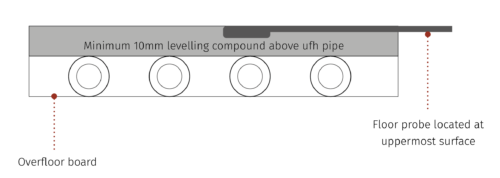
A thermostat or sensor that can accommodate a floor probe will protect your flooring from overheating. Cutting off the flow if it ever gets too warm. The floor probe needs to be in contact with the floor finish. When doing a selflevelling compound, allow the compound to cure and ensure the floor probe is placed on top, allowing it to be in contact with the floor finish. A small channel may need to be chased out of the compound to allow it to sit flat under the finish. Ensure these have been installed before laying your floor finish.
Download Wunda Rapid Response® floor coverings information