Carpet floor coverings
Carpets and rugs can be used with underfloor heating. But it is important to remember that as they are usually insulators, there are some limitations to the type of carpet or rug you choose. A floor finish that is an insulator will resist the rising heat and could stop it from coming through the floor into your room.
It’s always best to check with your supplier if their product is suitable for use with underfloor heating, but if you have any carpet related underfloor heating questions then feel free to get in touch. It is advised that 2.5 is the Max combined tog rating of the carpet, underlay and any intermediate layers.
These guidelines have been created to help you confidently install carpet over your Wunda Rapid Response® boards as part of a complete Wundafloor® system.
When installed correctly, your Wundafloor provides a stable, efficient, and highly responsive heated floor designed to work seamlessly with carpet.
Your carpet floor finish can be installed on the Rapid Response panels in a number of ways. In order for a smooth process, please take into account the following guidance:
Preparing your floor
Firstly, it is necessary to install battens up to the height of the panels (16/20mm) around the perimeter of the room and across door thresholds, allowing for gripper rods and door bars to be fixed without damaging pipe or panels.
Carpet Installation Method 1 – Duo Board
U04 – Duo board & Vapour barrier factsheet
Duo board
Firstly, Wunda Duo board can be used as an intermediate layer *before the Duo Boards are installed, lay an 800 gauge (200µm) vapour barrier over the top of the boards and pipework. (See document “U04” for details on the vapour barrier and laying.)
Duo board consists of 2 layers of HDF (high density fibre). The Bottom board is 3mm and top board is 3mm, so the total depth of the board is 6mm. The Duo board layers have 0.5Tog total of thermal resistance, so carpet and underlay combined need to be 2 tog or less. Duo board cannot be used in wet areas such as bathrooms due to the risk of the boards expanding when in contact with moisture.
Heat Pak: Bottom board = 4mm. Top board = 3mm*
- The Duo board is installed with the bottom board free floating. The bottom board has an adhesive layer for the top board to be adhered to, simply peel back the paper backing to expose the adhesive.
- The boards need to be laid in a staggered brick bond format so the joints are staggered and overlapping the joints in the bottom boards.
- When fitting the Duo boards in a room, leave an 8-10mm expansion gap around the perimeter of the room. An expansion joint needs to be allowed for every 8 linear meters of between 5 to 10mm and it can be filled using a flexible sealant or filler.
Carpet Installation Method 2 – Self Levelling Compound
Alternatively, an approved levelling compound can be used as an intermediate layer to give a smooth surface for the carpet and underlay. This would also mean perimeter strip is necessary to be fitted around the room to allow expansion.
It is important to carry out a pressure test of the floor heating system and pipes prior to applying any primers and levelling compounds.
Before pouring any levelling compounds, ensure that all Rapid Response® boards are securely bonded to the subfloor and that there is no movement in the boards. It is important that any movement in the boards or joints between boards is addressed and remedied before levelling compounds are poured. Additional Secure fixing of the boards may be required using large washers and screws, if movement is detected.
The aluminium of all unused pipe channel’s must be cut to expose the empty channel, ready for filling with your chosen levelling compound.
It is crucial to always prime the boards first with the approved and relevant primer, before laying the approved self levelling compound.
The Wunda approved Self Levelling compounds and Primers are:
‘10mm Ultra ProLevel Ultimate’, when primed first using ‘Ultra Prime it multi surface primer’.
‘10mm Mapei Ultraplan Renovation Screed’ when primed first with ‘Mapei Eco Prim Grip’.
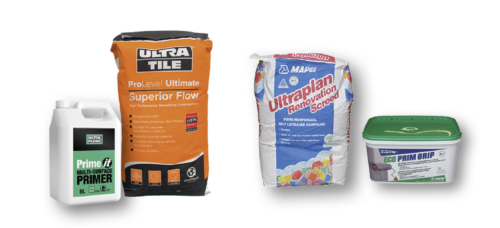
The levelling compounds and primers are not provided by Wunda. They can be sourced from local merchants or online and the relevant ratios will be included on their instructions.
Self Levelling Compound Curing Time
Tile adhesives and levelling compounds/screeds must be allowed to cure naturally. Be sure to check the manufacturer’s specific requirements. Do not use the underfloor heating system to accelerate the curing process.
When activating the heating, increase the temperature gradually. If you have a mixing valve begin with the it set to the minimum position and increase slowly by up to 5°C each day until the desired operating temperature is reached. If you are coming from a low temperature heat source, ensure the flow temperature supplied is low to start and slowly increased by up to 5°C each day until the desired operating temperature is reached.
Download Wunda Rapid Response® floor coverings information